

Practicing Presence
Foundational Principle:
As we learn to live like Jesus, we become conduits for the gospel where we live, work, and play.
Scripture to Begin:
John 1:14
And the Word became flesh and dwelt among us, and we have seen his glory, glory as of the only Son from the Father, full of grace and truth.
Learning
Jesus, in obedience to the Father, left heaven, took on human flesh, and came to dwell with us—this is what we call the incarnation. We celebrate this every Christmas. But this doctrine is much more than a baby in a manger. The incarnation should inform how we live our lives and engage with others. Missiologist Alan Hirsch says it well: “Our theology, our deepest codes, the deepest ways we think about God and how He engages the world, should inform our methodology.”
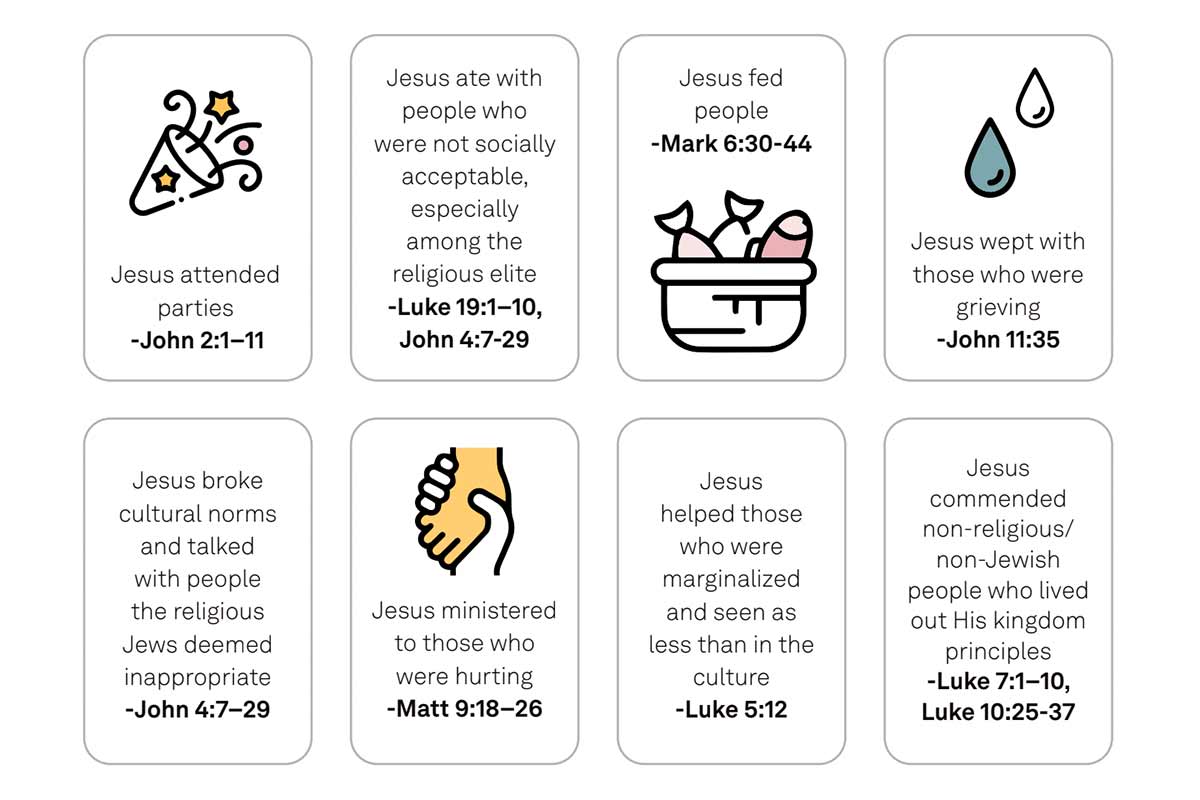
Only God incarnate can live a sinless life and die for our sins. Because of Jesus, we are called to represent Christ among others. Like Jesus, we are sent out to be his witnesses and ambassadors. We will attend parties, feed people, challenge cultural norms, etc., and like Jesus, we will be misunderstood, treated unjustly, and called to serve and to suffer for the sake of the gospel.
The Message says it so well:
“The Word became flesh and blood, and moved into the neighborhood. We saw the glory with our own eyes, the one-of-a-kind glory, like Father, like Son, generous inside and out, true from start to finish.” John 1:14
So what does this mean for us? Missiologist Brad Brisco introduces two key elements of incarnational ministry: proximity and presence.
“Incarnational missions must involve living in close proximity with others. We cannot love and serve those God has sent us to from a distance. Just as Jesus took on flesh and blood and moved into the neighborhood, we must do likewise. This may require moving geographically to be closer to those to whom God has sent us. At the very least, it will demand creating time and space to be directly and actively involved in the lives of people we are seeking to reach.”
It is helpful to recognize that Jesus’ words from John 20:21, “‘As the Father has sent me, I am sending you,’” are most often used to emphasize the sending of the disciples, and establishing the church. But we must not neglect the first half of the passage. Jesus says, “‘As the Father has sent me.’” The word translated “as” (or in some translations “just as”) means “like” or “in a similar manner.” In other words, we are sent like Jesus was sent by God the Father.”
Since Jesus is the perfect model for how we live a life that honors the Father and walk in
the Spirit, then it’s important for us to pay attention to how Jesus engaged with people.
Reflection
As you reflect on the life of Jesus and the people in His proximity and presence, what stands out to you? How does it make you feel when you think about the types of people Jesus connected with?
Applying What We Learn
As we heard from Alan Hirsch, oftentimes the theology of the incarnation doesn’t inform our methodology for reaching people with the gospel message. Look at the chart of what Jesus models for us in the gospels, choose one thing from the list that allows you to purposefully and practically interact with people in your corner of the world. How did this experience help you become more incarnational in your ministry?
GUIDE MAP
Start your journey to build up your local ministry here.
